期刊封面
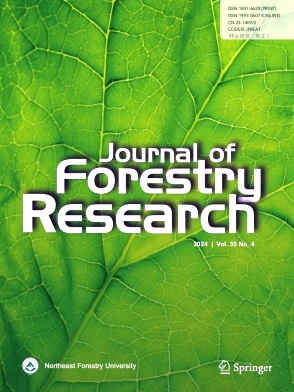
主办单位:东北林业大学
出版单位:黑龙江省哈尔滨市
期刊级别CA SCI JSTPж(AJ) EI CSCDWJCI 卓越期刊
影响因子:1.16
国际标准刊号ISSN:1007-662X
国内统一刊号:23-1409/S
出版周期:双月
创刊年份:1990
学科分类:农业科技
编辑团队:《林业研究》(英文版)编辑部
期刊宗旨和范围:坚持科技是第一生产力的原则,宣传和报道国内外森林生态学和森林资源学基础研究与应用研究方面的学术成果,为活跃学术空气、促进国际学术交流和科教兴国服务
栏目设置:主要刊登:森林经营、林木育种、造林、森林生态、森林土壤、森林保护、野生动物生态与管理、野生动物保护与利用、生物科学、木材科学、木材加工工艺、森林采运技术等方面的原始论文。同时,也刊登研究综述、研究简报、会议消息、书评方面的稿件。
Journal of Forestry Research 在线投稿
期刊简介:The Journal of Forestry Research (JFR), founded in 1990, is a peer-reviewed quarterly journal in English. JFR has rapidly emerged as an international journal published by Northeast Forestry University and Ecological Society of China in collaboration with Springer Verlag. The journal publishes scientific articles related to forestry for a broad range of international scientists, forest managers and practitioners.The scope of the journal covers the following five thematic categories and 20 subjects:
投稿指南:《林业研究(英文)》投稿须知 【官网信息】 Instructions for Authors Introduction Journal of Forestry Research (JFR) publishes scientific articles related to forestry for a broad range of international scientists, forest managers and practitioners. The scope of the journal covers the following 20 subjects: Tree genetics and tree breeding Tree physiology Silviculture Forest soil Forest hydrology Forest ecology Forest adaptation to climate change Restoration ecology Urban forestry Forest management Forest biometrics Forest RS, GIS, and modeling Forest health monitoring and assessment Forest fire Forest resource conservation Forest entomology and pathology Forest biomass, carbon, and bioenergy Forest engineering Wood science and biomaterials Wildlife ecology and management Although JFR is a comprehensive academic journal covering nearly all subjects of forestry, this journal does not publish papers related to forest economics, medicinal plants, fruit trees, landscape architecture, horticulture, aquatic organisms, technologies for extractions, the composition of wood, wood products technology and pulp processing, and manufacturing methods, as well as other subjects addressed in detail by other journals. The journal welcomes review articles, original papers, and short communications with high academic quality. The journal seeks manuscripts reporting breakthroughs in knowledge, approaches or techniques, and understanding across a broad spectrum of forests and forestry. All papers are subject to peer review. Submissions are judged on their originality, the importance of their subject matter, and their clarity, accuracy, and quality of scientific writing. Required Reading before Submission Ethical responsibilities of authors This journal is committed to upholding the integrity of the scientific record. As a member of the Committee on Publication Ethics (COPE), the journal follows the COPE guidelines on how to deal with potential acts of misconduct. Authors should refrain from misrepresenting research results which could damage the trust in the journal and ultimately the entire scientific endeavour. Maintaining integrity of the research and its presentation can be achieved by following the rules of good scientific practice, which includes: • The manuscript has not been submitted to more than one journal for simultaneous consideration. • The manuscript has not been published previously (partly or in full), unless the new work concerns an expansion of previous work (please provide transparency on the re-use of material to avoid the hint of text-recycling (“self-plagiarism”)). • A single study is not split up into several parts to increase the quantity of submissions and submitted to various journals or to one journal over time (e.g. “salami-publishing”). • No data have been fabricated or manipulated (including images) to support your conclusions • No data, text, or theories by others are presented as if they were the authors own (“plagiarism”). Proper acknowledgements to other works must be given (this includes material that is closely copied (near verbatim), summarized and/or paraphrased), quotation marks are used for verbatim copying of material, and permissions are secured for material that is copyrighted. Important note: the journal may use software to screen for plagiarism. • Consent to submit has been received from all co-authors and responsible authorities at the institute/organization where the work has been carried out before the work is submitted. • Authors whose names appear on the submission have contributed sufficiently to the scientific work and therefore share collective responsibility and accountability for the results. In addition: • Changes of authorship or in the order of authors are not accepted after acceptance of a manuscript. • Requests to add or delete authors at revision stage or after publication is a serious matter, and may be considered only after receipt of written approval from all authors and detailed explanation about the role/deletion of the new/deleted author. The decision on accepting the change rests with the Editor-in-Chief of the journal. • Upon request authors should be prepared to send relevant documentation or data in order to verify the validity of the results. This could be in the form of raw data, samples, records, etc. If there is a suspicion of misconduct, the journal will carry out an investigation following the COPE guidelines. If, after investigation, the allegation seems to raise valid concerns, the accused author will be contacted and given an opportunity to address the issue. If misconduct has been proven, this may result in the Editor-in-Chief’s implementation of the following measures, including, but not limited to: If the article is still under consideration, it may be rejected and returned to the author. If the article has already been published online, depending on the nature and severity of the infraction, either an erratum will be placed with the article or in severe cases complete retraction of the article will occur. The reason must be given in the published erratum or retraction note. The author’s institution may be informed. Disclosure of potential conflict of interests Authors must disclose all relationships or interests that could influence or bias the work. Although an author may not feel there are conflicts, disclosure of relationships and interests affords a more transparent process, leading to an accurate and objective assessment of the work. Awareness of real or perceived conflicts of interests is a perspective to which the readers are entitled and is not meant to imply that a financial relationship with an organization that sponsored the research or compensation for consultancy work is inappropriate. Examples of potential conflicts of interests that are directly or indirectly related to the research may include but are not limited to the following: • Research grants from funding agencies (please give the research funder and the grant number) • Honoraria for speaking at symposia • Financial support for attending symposia • Financial support for educational programs • Employment or consultation • Support from a project sponsor • Position on advisory board or board of directors or other type of management relationships • Multiple affiliations • Financial relationships, for example equity ownership or investment interest • Intellectual property rights (e.g. patents, copyrights and royalties from such rights) • Holdings of spouse and/or children that may have financial interest in the work
投稿方式:在线投稿
联系方式:1、投稿方式:在线投稿。 2、刊内网址: http://www.springer.com/11676(202304期) 3、投稿系统: https://www.editorialmanager.com/jfr/ 4、出刊日期:双月刊,逢双月出版。
定价:768.00